About Dora
One of thirteen who survived. Four decades who didn't waste it.
From a coffee-growing town in El Salvador, to a near-fatal crossing of the Sonoran Desert, to four decades of social work and advocacy in Tucson, this is Dora Rodriguez's story, in her own trajectory.
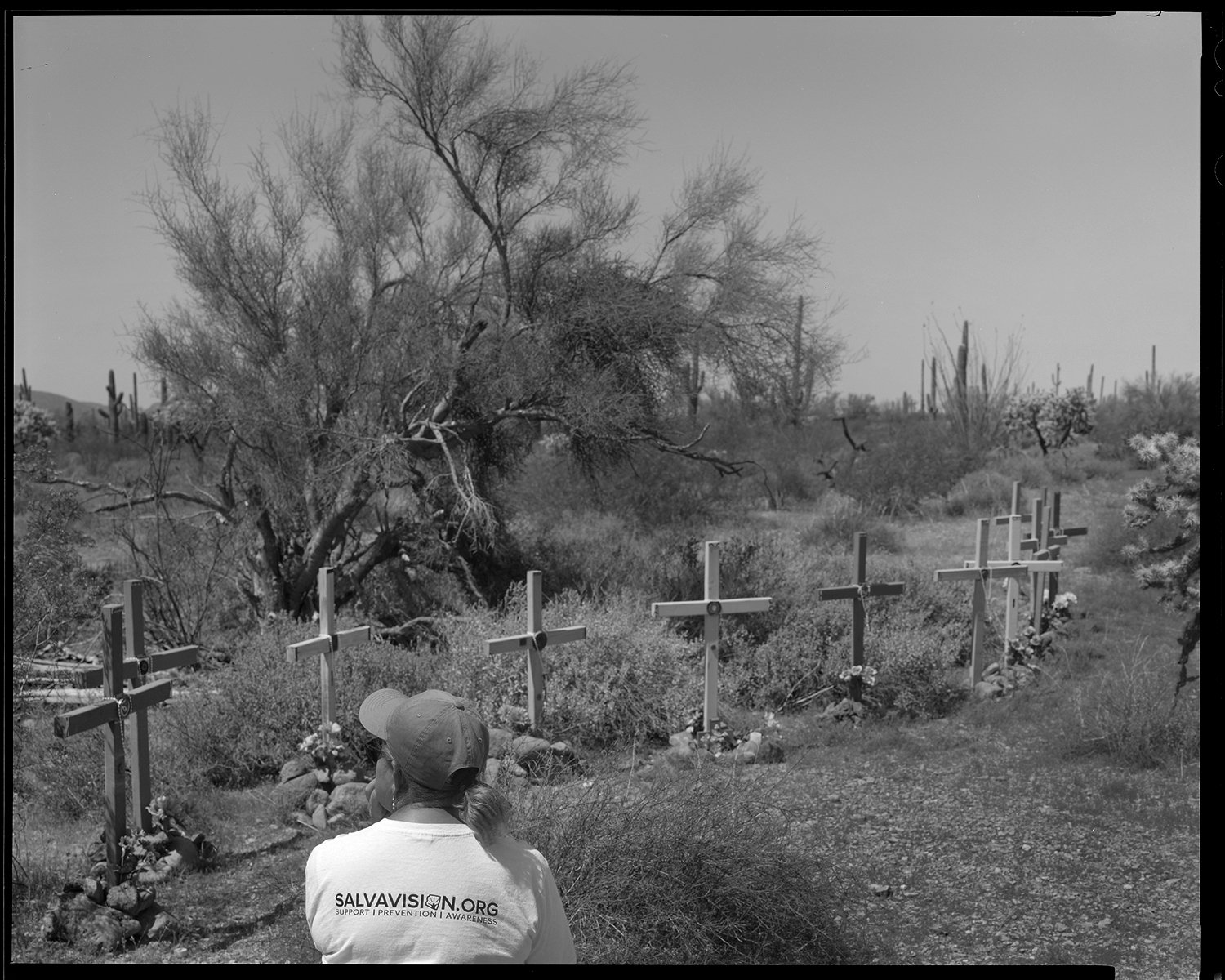
Crosses mark the site in Organ Pipe Cactus National Monument where thirteen members of Dora's group died in 1980.
Santa Ana, El Salvador
Dora grew up in Santa Ana, in a family that spent summers together in the coffee fields, hard but joyful work she still remembers fondly. But by 1980, El Salvador's civil war had reached her town. Friends and fellow community health workers were disappearing. Death squads operated with impunity. Her mother made the wrenching decision that Dora needed to leave.
Dora was 19. She made two earlier attempts to reach the United States, captured and deported once after climbing the border fence near Tijuana, turned back a second time after crossing into Yuma. In June 1980, she set out a third time, traveling with a group of 26 that included her uncle and cousin, guided by smugglers through the Sonoran Desert.
The Crossing
The group lost their way in Organ Pipe Cactus National Monument. Water ran out. Over several days in triple-digit heat, the group was reduced to drinking urine and cologne in desperation. Dora became close with three teenage sisters in the group (Alicia, Inés, and Juanita) whose memory she honors throughout her memoir.
Thirteen members of the group died in the desert. Dora was found alive, but barely, carried out of the Ajo Valley in a moment that was photographed and ran on front pages across the country. That image became one of the catalysts for the sanctuary movement that soon took root in Tucson, when the Rev. John Fife opened the doors of Southside Presbyterian Church to Central Americans fleeing war.
Rebuilding, in Service of Others
Dora stayed in Tucson. She built a life and a career around the conviction that her survival came with a responsibility. She became a social worker, raised five children, and fostered many more, all while quietly carrying the story of what happened in 1980 for over three decades.
In 2016, watching political rhetoric increasingly characterize migrants as criminals, Dora decided it was time to speak publicly. What began as occasional interviews grew into a full second calling: public speaking, media advocacy, and direct humanitarian work.
Salvavision
Turning lived experience into direct aid.
Dora founded Salvavision to make sure no one crossing the desert faces it as alone as she did.
Direct Humanitarian Aid
Salvavision provides water, food, and emergency supplies along migrant trails in the Sonoran Desert, and support for deportees navigating return to Mexico.
Casa de la Esperanza
Dora co-founded this migrant resource center in Sasabe, Sonora, offering shelter, food, and orientation to people navigating the border region.
Resiliencia Publishing
A justice-driven imprint Dora founded to amplify the voices of migrants, survivors, and organizers, starting with her own memoir.
"I heal in honor of my friends."Opening line, Dora: A Daughter of Unforgiving Terrain
Today
Dora lives in Tucson, Arizona, with her husband. She's a proud mother of five and a grandmother. She continues to serve as Founder and Director of Salvavision, and in 2025 published her memoir, Dora: A Daughter of Unforgiving Terrain, co-written with Abbey Carpenter, and named a Southwest Book of the Year, Top Pick by the Pima County Public Library.
She speaks regularly at universities, libraries, faith communities, and conferences across the country, and has been featured by NPR, The New York Times, AP News, KJZZ, The Intercept, and in the documentary Deserted, directed by Jason Motlagh.
Book Dora for Your Event